To Relate To The Root
A forage themed on unlearning that 'radical' means extreme. To relate to the root of what is vital to life is to wake up by moving down into reality, and to practice change with others from the ground up.
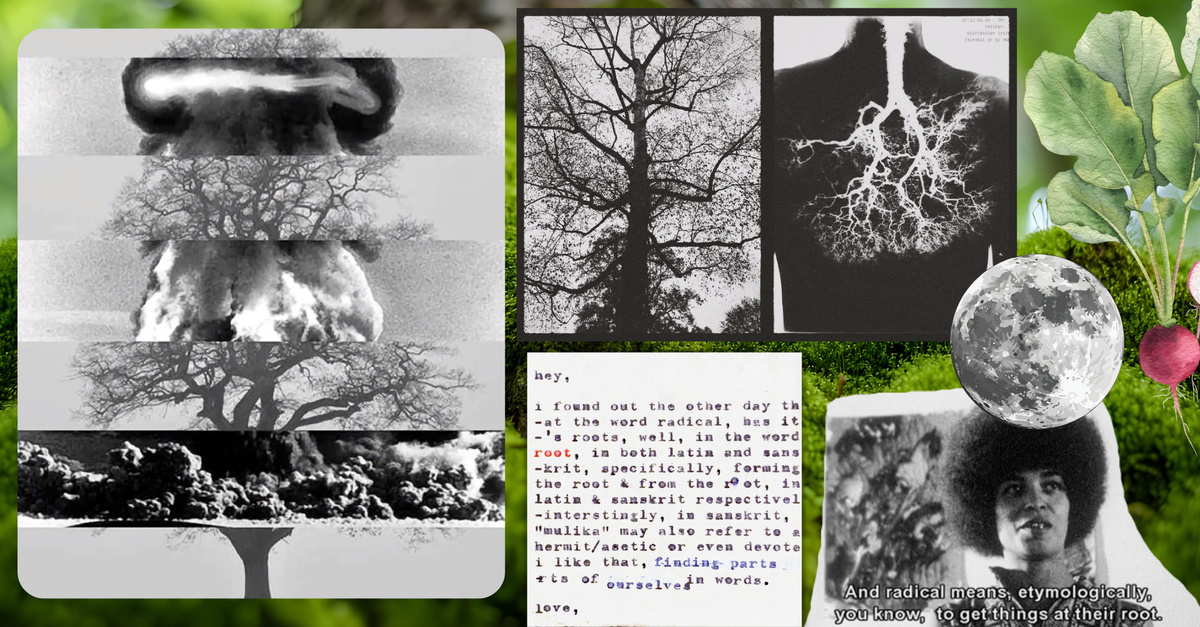
This moon's theme is radical: The most basic sense of the word radical in all its meanings is about relating to the roots of what is vital to life. The first sound of radical has a Proto-Indo-European root meaning branch or root. The word radical is related to radish, rhizome, deracinate. It started in the 1300s meaning "originating in the ground", from the Latin radicalis, "of or having roots." Then in the 1650s the figurative meaning "going to the origin, essential" appeared, then in the 1780s it took on the political meaning of "radical reform" to change from the roots, it began to mean "unconventional" in 1921, and became US youth and surfer slang from the 1970s to the 1980s. These days it's been branded to something unlikeably extreme, and so I've gathered 15 reading highlights to try recover its root meaning.
- To grasp things at the root | Angela Davis in 1987 paraphrased Marx when she said the word radical simply means grasping things at the root.[1]
- The root is human | Theory can become a material force when it grips the masses by going to the root of our current conditions, said Karl Marx in 1843.[2]
- To wake up is to move down | Rather than transcending above all suffering, the path to waking up from fear is actually to go down into your struggles with millions of others, said American Buddhist nun Pema Chödrön in 2002.[3] At the root we discover bodhichitta, a love that will not die.
- Willing to do different things | At which point is one radicalised? Ismatu Gwendolyn thinks it's not when you begin to think differently, but instead when you are willing to do different things.[4]
- Fully entering into reality | The more radical someone is, the more committed to human liberation they are, said Paulo Freire in 1968. This means they commit themself within history on the side of the oppressed, and fully enter into reality: to know it better, to change it.[5]
- The root of intimacy | A radical intimacy is one that gets to the root of how capitalism psychically and materially shapes our intimate lives, said Sophie K. Rosa— and that to remake the world, we must view connection, care, and community as sites of revolutionary struggle.[6]
- At the root is children | At the root of every hierarchy, abuse cycle, and domination act in the world is our dehumanisation of children, said Stinney Distro.[7]
- Back into our pasts | Despite their best intentions, a self-organised leaderless radical therapy group that grew out of small informal meetings in 1970s working-class East London still had to go back to their childhood to liberate themselves.[8]
- The root argument of radical antiracism | Arun Kundnani in 2023 differentiated between the liberal antiracism articulated as a response to Nazism in the 1930s and the radical antiracism that sprouted amongst peoples dominated by European colonialism.[9] The root argument of radical antiracism is that racism must be understood through the economic and political structures that distribute resources.
- Worker solidarity | Nathan DuFord in 2022 said that worker solidarity is radical because it goes to the root economically and politically: (1) economically, it challenges the late capitalist logic of organising workers as exploitable and replaceable; (2) politically, it challenges idea that you should only look out for yourself and accept the way things are.[10] Actions of collective refusal by workers are radical because they defy the idea of individualism.
- To meaningfully depart from systems in place | Radical action meaningfully departs from the systems we have in place and heads towards collective sovereignty. It requires creativity, bravery, endurance, and a communion. To start practicing with other people is the hardest part, said Ismatu Gwendolyn, and once you start the doing with others, it gets easier and easier.[11]
- The practical response to a world on fire | Far from being extreme, the radical is the practical response to a world on fire, said J.P. Hill in 2024.[12] When you live in a status quo of "often remarkable violence rendered normal or mundane" through corporations, settler-colonial violence, and uncaring governments, presenting an alternative to business-as-usual is both the right thing to do and good politics.
- Radical realism in planetary politics | Radical realism in climate politics means you start with how things actually are right now, not how you wish they were, said Ajay Singh Chaudhary in 2024.[13] You look at the real climate, real pollution, real economies, and real geopolitical conflicts. Base your decisions on today's concrete and interrelated ecological and social conditions. We don't get to pretend that nature, weather, resources are separate from politics, money, power. You work with what is really here instead of a perfect dream of what you hope will be here someday.
- Resist the assumptions | Even though nonprofit workers are constrained and exploited, they are not simply reproducing the logics and harms of the nonprofit industrial complex. Power in the complex does not only flow from top down agendas. Nonprofit workers shape their broader work conditions too, and can subvert the nonprofit form to serve radical commitments, said Soniya Munshi and Craig Willse in 2017.[14]
- They will call you violent | Kelly Hayes and Mariame Kaba in 2023 said that when a radical concept or movement breaks into mainstream, authority's first reaction is to remove it. If it cannot be removed, then structural maintenance workers will try to turn it into harmless expression or political wallpaper. If that fails, it will be condemned as violence. You will be called violent any way you disrupt the "peace" of mass death systems. Whether you do it passively, destructively, through mutual aid, the elastic concepts of criminality and violence as controlled by the powerful will always be used against you. Instead of defining the bounds of your morality and action by their standards, expose and dismantle "the supposed moral frameworks of the death-makers."[15]
1. To grasp things at the root
It should be clear that there are forces in our society that reap enormous benefits from the persistent, deepening oppression of women. Members of the Reagan administration include advocates for the most racist, antiworking class, and sexist circles of contemporary monopoly capitalism. These corporations continue to prop up apartheid in South Africa and to profit from the spiraling arms race while they propose the most vulgar and irrational forms of anti-Sovietism—invoking, for example, the “evil empire” image popularized by Ronald Reagan—as justifications for their omnicidal ventures. If we are not afraid to adopt a revolutionary stance—if, indeed, we wish to be radical in our quest for change—then we must get to the root of our oppression. After all, radical simply means 'grasping things at the root.' Our agenda for women’s empowerment must thus be unequivocal in our challenge to monopoly capitalism as a major obstacle to the achievement of equality.
— Angela Davis, 25 June 1987
2. The root is human
The weapon of criticism cannot, of course, replace criticism of the weapon, material force must be overthrown by material force; but theory also becomes a material force as soon as it has gripped the masses. Theory is capable of gripping the masses as soon as it demonstrates ad hominem, and it demonstrates ad hominem as soon as it becomes radical. To be radical is to grasp the root of the matter. But, for man, the root is man himself.
— Karl Marx, 1843
3. To wake up is to move down
On the journey of the warrior-bodhisattva, the path goes down, not up, as if the mountain pointed toward the earth instead of the sky. Instead of transcending the suffering of all creatures, we move toward turbulence and doubt however we can. We explore the reality and unpredictability of insecurity and pain, and we try not to push it away. If it takes years, if it takes lifetimes, we let it be as it is. At our own pace, without speed or aggression, we move down and down and down. With us move millions of others, our companions in awakening from fear. At the bottom we discover water, the healing water of bodhichitta. Bodhichitta is our heart — our wounded, softened heart. Right down there in the thick of things, we discover the love that will not die. This love is bodhichitta. It is gentle and warm; it is clear and sharp; it is open and spacious. The awakened heart of bodhichitta is the basic goodness of all beings.
— Pema Chödrön, 2002
4. Willing to do different things
I think that radicalization is the point in time, not in which you begin to think different things, but the point in time in which you are willing to do different things.
— Ismatu Gwendolyn, 2025
5. Fully entering into reality
The radical, committed to human liberation, does not become the prisoner of a "circle of certainty' within which reality is also imprisoned. On the contrary, the more radical the person is, the more fully he or she enters into reality so that, knowing it better, he or she can better transform it. This individual is not afraid to confront, to listen, to see the world unveiled. This person is not afraid to meet the people or to enter into dialogue with them. This person does not consider himself or herself the proprietor of history or of all people, or the liberator of the oppressed; but he or she does commit himself or herself, within history, to fight at their side.
— Paulo Freire, 1968
6. The root of intimacy
What, then, might ‘radical intimacy’ mean? At first sight, the term could be interpreted as an ‘extreme’ intimacy: deep intimacy as symbiosis. This is not really what ‘radical intimacy’ refers to here; though it is not not this, either. Rather, ‘radical’ is used to refer to political radicalism: a politics with imagination and abolitionism at its core, that seeks to transform the world by getting to the root of why things are the way they are under capitalism. For example, rather than campaigning for more police on the streets to ‘protect women’, a radical feminist politics demands police abolition, identifying the carceral state as a root of patriarchal violence. Or, as opposed to more lenient border enforcement to make life better for migrants, a radical demand would be border abolition, recognising that borders are not immutable and that their very existence is a root of racist violence. Abolition insists upon nothing less than liberation; as the prison abolitionist and scholar Ruth Wilson Gilmore has said, it ‘is about presence, not absence. It’s about building life-affirming institutions.”[16]
In this way, ‘radical intimacy’ aims to get to the root of intimacy as we know it. It explores the ways capitalism psychically and materially predetermines, infiltrates and thwarts our intimate lives. It reflects upon why this matters, and what resistance in this realm could mean. Radical intimacy considers, as the scholar and filmmaker Susan Stryker writes, how the state and its ideologies often ‘regulate bodies, in ways both great and small, by enmeshing them within norms and expectations that determine what kinds of lives are deemed livable or useful and by shutting down the space of possibility and imaginative transformation where peoples’ lives begin to exceed and escape the state’s use for them’.[17] Radical intimacy insists that to remake the world we must pay attention to connection, care and community as sites of struggle. Doing so could bring us closer – to ourselves and to each other – in ways that fuel our struggles towards revolutionary horizons.
— Sophie K. Rosa, 2023
7. At the root is children
Every hierarchy, every abuse, every act of domination that seeks to justify or excuse itself appeals through analogy to the rule of adults over children. We are all indoctrinated from birth in ways of 'because I said so.' The flags of supposed experience, benevolence, and familial obligation are the first of many paraded through our lives to celebrate the suppression of our agency, the dismissal of our desires, the reduction of our personhood. Our whole world is caught in a cycle of abuse, largely unexamined and unnamed. And at its root lies our dehumanization of children.
— Stinney Distro, 2023
8. Back into our pasts
We wanted to work together politically in non-hierarchical ways, find some kind of sexual freedom and non-oppressive relationships between men and women and adults and children. I think we found it was ALL HARDER THAN WE THOUGHT – that we couldn’t somehow will ourselves liberated and wake-up the next morning feeling wonderfully collective, non-jealous, confident, non-competitive etc. We couldn’t suddenly change the patterns of a lifetime which we had been forced to conform to in this society. The changes had to take place at a deeper level than just intellectual and political understanding. We had to go back into our pasts, unlearn our conditioning, break out of the blocks that had been instilled into us since childhood.
— Red Therapy, 1978
9. The root argument of radical antiracism
Liberals have been arguing for a century that racism is fundamentally an individual problem of irrationally held beliefs and prejudiced attitudes. In the 1930s, this claim accompanied new ideas about the value of cultural diversity, replacing the scientifically discredited doctrine of racial superiority. Liberal antiracists developed their ideas in response to Nazism, which, to them, showed the danger of political extremists capitalizing on mass prejudices and bringing about the collapse of liberal democracy. In response, they called upon US elites to lead a process of teaching people to be less prejudiced, especially among the uneducated and economically insecure. In these ideas from the 1930s lies the origin of how liberals think about antiracism today, from the enthusiasm for diversity training to the hope that better representation in Hollywood movies can educate us out of our racist attitudes. In these ideas from the 1930s lies the origin of how liberals think about antiracism today, from the enthusiasm for diversity training to the hope that better representation in Hollywood movies can educate us out of our racist attitudes. Alongside the growth of this liberal antiracism, a more radical antiracism flowered. It first sprouted among peoples dominated by European colonialism. The root argument was that racism had to be understood in terms of the broad economic and political structures through which societies were organized. These radicals saw racism as closely tied to colonialism and capitalism; a central question focused on the racial distribution of resources. And only with the organized collective action of Black and Third World peoples could these structures be changed. In the 1960s, the Black freedom movement popularized these kinds of radical antiracist arguments in the US. But in the 1970s, ruling classes mobilized a neoliberal conception of market forces to defeat mass movements for the redistribution of wealth, reconfigure Western domination of the Third World, and erect new structures of racism. By this time, liberal antiracism could claim to have succeeded in achieving something of a reduction in the extent to which racial prejudices affected interpersonal relationships— progress in this sphere, at least. But liberal antiracism was powerless against the new forces of structural racism. What’s more, its venerations of diversity and individualism were easily co-opted to shore up the new racist system.
— Arun Kundnani, 2023
10. Worker solidarity
Some moves are inaccessible to us, given the current dominative institutions and cultures in which we act: in particular, the culture of liberalism as it creates both atomized individuals and a consensus on the current politico-economic system. It is a system that harms more people than it benefits, and leaves those it has harmed without the recourse of the social democratic welfare state. It is only natural that in such a world, labor solidarity would come to be seen as "special." Labor solidarity is radical in the sense that it goes to the root. This happens on two registers: the economic, in challenging the late capitalist structure of labor, and the political, in challenging the injunction to be self-oriented and go along with the consensus.
— Nathan DuFord, 2022
11. To meaningfully depart from systems in place
The hardest part about radical action— radical as in to meaningfully depart from the systems that we have in place— is starting. The hardest part is starting beyond the thinking, the posting, the reading, the physical actions that pull your life into different directions. That's the hardest part. From there, gets easier and easier to continue to make these decisions because your life is going in a particular direction. Radicalism requires a creativity and a bravery and an endurance and a communion. It requires you to have people to do it with you. How do you get there from watching a video on the internet? You know what I'm saying? What would all this be for if I did not use this mass of people to bring us closer to collective sovereignty?
— Ismatu Gwendolyn, 2025
12. The practical response to a world on fire
Detractors from radical movements and organizations often say that their more militant counterparts behave in a way that is inherently antithetical to mass movement, and thus contrary to their own aims. That is not only untrue; it obscures a more important lesson. We live in a society where the status quo itself is extreme, whether it be the normalization of police killing over 1,000 people per year, corporations running so rampant that we all have microplastics inside our bodies, our government fueling genocide, or any number of other examples. The status quo is often remarkable violence rendered normal or mundane. […] People are hungry for something more, for something beyond business as usual. And presenting that alternative isn’t just the right thing to do, it’s good politics. If what you’re interested in is building and winning a better world, a bold vision presented in a way folks can hear is vital to victory. It takes work, a lot of work and a lot of conversations, but the left has answers that a whole lot of people are looking for, so don’t shy away from offering transformative solutions to the problems we face. Lean into it and bring folks along with you. The radical is, ultimately, the practical response to a world on fire.
— J.P. Hill, 2024
13. Radical realism in planetary politics
Any climate politics must start from “the way things are” — those actual conditions; must work through historically situated conflicts therein; analytically, practically, and theoretically, the mutual exclusivity of contending positions results in modes of domination and conflict. Climate change presses the question. Radical realism in the context of climate doesn’t mean all questions of compromise, of the imperfect, are discarded, but it begins from today’s concrete, fundamentally interrelated ecological and social conditions; its baseline similarly builds from actually inseparable ecological and social necessities.
— Ajay Singh Chaudhary, 2024
14. Resist the assumptions
While paying critical attention to differences within the academic industrial complex (AIC) and the non-profit industrial complex (NPIC), we also must be cautious not to mistake the individuals in those settings for the institutions themselves. Life within the NPIC and AIC requires constant negotiation of how those complexes constrain and enable transformative work. In those negotiations, individuals are not only shaped by their institutional locations but also push back and shape their organizations, universities, and broader contexts. One way to attend to these dynamics is to consider that most people are positioned within the AIC or the NPIC as workers and as such find themselves caught between their own exploitation and the promises and pitfalls of their schools and organizations. Workers in non-profit organizations, like any workers, navigate the demands and restrictions of their jobs and the conditions of their workplaces. Non-profit workers are often members of the same communities that their organizations address, and as people of color, women, queer and trans people, and immigrants are also targeted and made vulnerable by the same systems of exploitation and oppression that they challenge in their work. To the extent that non-profit organizations maintain the status quo, these forms of violence, including racism, sexism, homophobia, transphobia, and ableism are reproduced internally in these settings. Despite these precarious and exploitative conditions, non-profit workers do more than simply reproduce the logics and further the harms of the nonprofit industrial complex. The priorities and agendas of non-profit organizations are often set by workers with political commitments and values that resist the assumptions of the NPIC and subvert or manipulate the non-profit form to serve radical commitments. This can include centering the most vulnerable or marginalized members of the community through internal structures and mobilizing resources to support this work. Non-profit workers also educate funders and advocate for policy change, two channels through which they shape the broader conditions within which non-profits do their work. Such work exceeds service provision or programmatic activities, claiming space and resources for radical and transformative projects.
— Soniya Munshi and Craig Willse, 2017
15. They will call you violent
When a radical concept or movement forces its way into the mainstream, the first reaction of authority is to eject it. But if that radical presence cannot be ejected, structural maintenance workers—such as public officials and others who benefit from the status quo—will attempt to defang and reconfigure it so that the concept or movement is no longer disruptive to the order of things. When such efforts are successful, disruption gives way to mere expression, and the powerful applaud themselves for welcoming or even participating in that expression. What was once an intervention becomes political wallpaper. Radicalism that is not successfully co-opted or defanged, that continues to linger within the mainstream, will be met with increasing hostility and, ultimately, condemned as associated with violence. As Táíwò writes in Elite Capture, “Where co-optation fails, regular old repression will do.”[18] [...] The maintenance of global capitalism necessitates mass death, just as the maintenance of capitalism in the United States requires the violence of the carceral system. If these systems function without interruption, you will be told you are experiencing “peace.” After all, police are often cast as “peace officers,” and soldiers are called “peacekeepers.” If you choose to disrupt these systems, passively, destructively, or by way of extending mutual aid, the concept of violence may be stretched and manipulated by the powerful to encompass your work. That is why we must not allow the frameworks of the powerful to define the bounds of morality in our politics and our action. The elastic concepts of criminality and violence, as controlled by the powerful, will always be bent against us. Instead, we must expose and dismantle the supposed moral frameworks of the death-makers. We must craft our own narratives and uplift our own frameworks, which implicate the system itself.
— Kelly Hayes and Mariame Kaba, 2023
Angela Davis, "Let Us All Rise Together: Radical Perspectives on Empowerment for Afro-American Women", an address to the National Women's Studies Conference at Spelman College, June 25, 1987. ↩︎
Karl Marx (1843). https://www.are.na/block/45793189 ↩︎
Pema Chödrön (2002). Comfortable with Uncertainty: 108 Teachings on Cultivating Fearlessness and Compassion. Shambhala. ↩︎
Ismatu Gwendolyn (26 Feb 2025). Ismatu Gwendolyn: Class Traitor. https://www.threadings.io/ismatu-gwendolyn-class-traitor-2/ ↩︎
Paulo Freire (1968). Pedagogy of the Oppressed. ↩︎
Sophie K. Rosa (2023). Radical Intimacy. Pluto Press. ↩︎
Stinney Distro (2023). No!: Against Adult Supremacy. https://www.activedistributionshop.org/product/no-against-adult-supremacy/ ↩︎
Hannah Proctor (2024). Burnout: The Emotional Experience of Political Defeat. Verso. Hannah accessed this in the East London Big Flame archives at May Day Rooms, and added in a footnote: "Co-written by two former members of Red Therapy and dedicated to the group, Sheila Ernst and Lucy Goodison’s In Our Own Hands: A Book of Self-Help Therapy (London: Women’s Press, 1981) expresses similar sentiments in its introduction: ‘We hoped that if we could understand how certain attitudes were socially determined, we could, by a conscious act of will, choose to change or banish them. But even within a growing and effective movement active in the world, and with a radical restructuring of domestic life, our feelings and relationships did not change easily. Women were gaining new power but continued to feel depressed, inadequate and confused." https://www.are.na/block/39989143 ↩︎
Arun Kundnani (2023). What Is Antiracism? And Why It Means Anticapitalism. Verso Books. ↩︎
Nathan Rochelle DuFord (2022). Solidarity in Conflict: A Democratic Theory. Stanford University Press. ↩︎
Ismatu Gwendolyn (12 Jul 2025). Project Feasibility: on Becoming an “algorithmically elected official." https://www.threadings.io/aqotp-yes-i-do-mean-algorithmically-elected-official/ ↩︎
J.P. Hill (13 Oct 2024). Being Radical is Practical. New Means https://www.jphilll.com/p/being-radical-is-practical ↩︎
Ajay Singh Chaudhary (2024). The Exhausted of the Earth: Politics in a Burning World. Repeater Books ↩︎
INCITE! Women of Color Against Violence (2017). The Revolution Will Not Be Funded: Beyond The Non-Profit Industrial Complex. Duke University Press https://www.dukeupress.edu/the-revolution-will-not-be-funded ↩︎
Kelly Hayes and Mariame Kaba (2023). Let This Radicalize You: Organizing And The Revolution Of Reciprocal Care. Haymarket Books. ↩︎
Quoted by Karis Clark (19 Apr 2021). Abolition is. The Michigan Daily https://www.michigandaily.com/michigan-in-color/abolition-is/ ↩︎
Susan Stryker (2008). Transgender History . Seal Press, p. 51. ↩︎
Olúfẹ́mi O. Táíwò (2022). Elite Capture: How the Powerful Took Over Identity Politics (and Everything Else). Haymarket Books. ↩︎
More foraging
More narrative resources gathered in this context here: are.na/liy/a-radical-relates-to-the-root