To Recognise The Stranger
Recognition is to re-perceive what you have known all along but not yet confronted. For example: There is no stranger; everyone you are looking at is also you. A forage after reading Isabella Hammad.
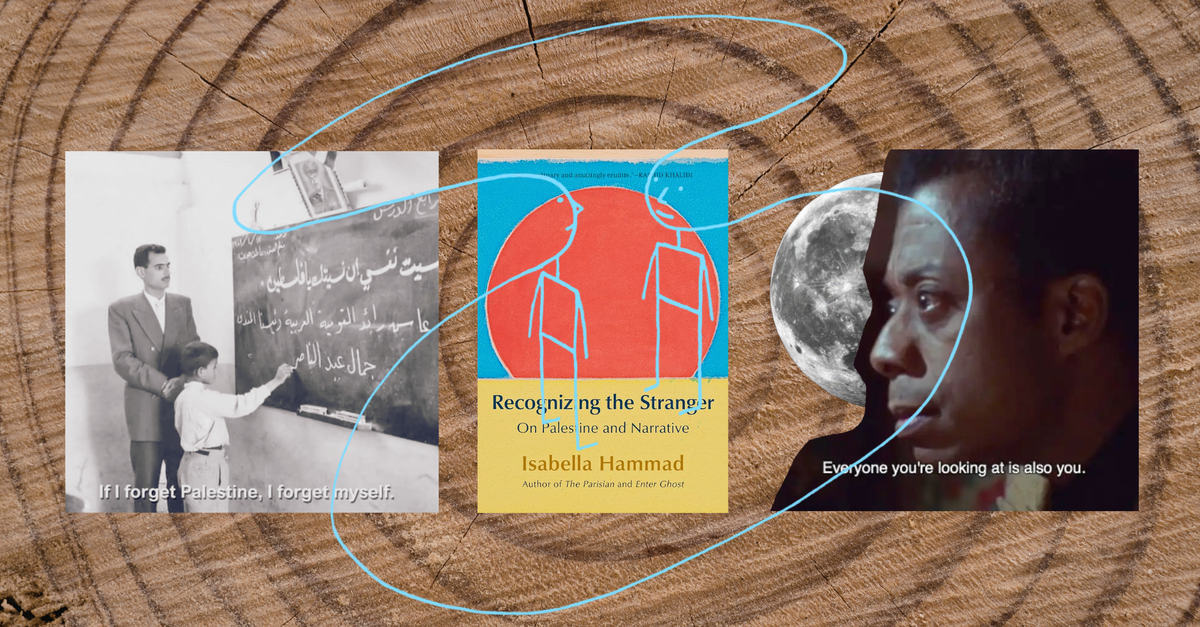
This moon's theme is inspired by Isabella Hammad's book Recognizing The Stranger: On Palestine and Narrative which I read in October 2024.
We who are not there, witnessing from afar, in what ways are we mutilating ourselves when we dissociate to cope? To remain human at this juncture is to remain in agony. Let us remain there: it is the more honest place from which to speak.
— Isabella Hammad
Since finishing it, I found that other things would take me back there, including a Qur'ān verse, which I write a bit about below.
- I am you
- Accumulated knowledge, unconfronted
- That is also you
- It was the neighbour
- When the line collapses
- That is my daughter
- The way we treat ourselves
- To recognise each other
- Denying affinity is self-alienation
- Say that's me
- My child, my mother, my father
- Recap / Summary
I am you
In 2024, Fariha Róisín read a tribute to Palestinian poet Refaat Alareer[1] before performing his 2012 poem "I AM YOU."[2]
Accumulated knowledge, unconfronted
The novel A Heart So White, by the Spanish writer Javier Marías, begins with the words “I did not want to know but I have since come to know.” Encased in this “I did not want to know” is an already-knowing. The reversal hastened by recognition functions only on account of an accumulation of knowledge, knowledge that has not been confronted. That’s why it’s re-cognition; ana-gnorisis: knowing again. In an interview, Marías said that while for some the novel “is a way of imparting knowledge,” for him “it is more a way of imparting recognition of things that you didn’t know you knew. You say ‘yes.’ It feels true even though it might be uncomfortable.” To recognize something is, then, to perceive clearly what on some level you have known all along, but that perhaps you did not want to know.
— Isabella Hammad, 2024
That is also you
“The world is held together, really it is, held together, by the love and the passion of a very few people. Otherwise, of course you can despair. Walk down the street of any city, any afternoon, and look around you. What you’ve got to remember is what you’re looking at is also you. Everyone you’re looking at is also you. You could be that person. You could be that monster, you could be that cop. And you have to decide, in yourself, not to be.”
— James Baldwin on the Dick Cavett Show, 1979
It was the neighbour
"It was not Hitler or Himmler who abducted me, beat me, and shot my family. It was the shoemaker, the milkman, the neighbor, who received a uniform and then believed they were the master race."
— Roma Auschwitz survivor Karl Stojka
When the line collapses
How do we love others and ourselves, truly, not just say it, but feel it? How do you love a person who betrayed you, who hurt you, who disgusts you? Here's the part that sounds impossible until it's felt: The person you call the worst human you've ever met is YOU in another set of causes, of configurations. Not metaphorically, literally. If you were born with their brain, their body, their teachers, their causes, their moment-to-moment conditioning, you would be exactly the same. Everything, including who you are, arises from something else. [...] You don't love others out of virtue. You love them because the line between them and you collapses. I'm not gonna hate that person; I wouldn't hate myself if I were them.
— Robyn Humphrys, 2025
That is my daughter
My daughter was riding her bike the other day. And she fell and skinned up her face pretty bad. We had to go to urgent care. She's crying, I'm carrying her. And all I could think about was parents in Gaza. [...] Hind Rajab is like... my daughter is 5, so that's my daughter. My son is nonverbal, has some other disabilities. That Muhammad, the boy who was killed by a dog. Like, that's my son. [...] I don't know if there's a way for America to come back from this in the sense of our reputation on the international stage. We've completely trashed these institutions, ICC, ICJ, the UN, for the benefit of what? To protect someone like Netanyahu and what Israel is doing. I hope that Palestinians can have the determination and autonomy to live their lives. I think Palestinians are just like me. They have families, they want to do things with their life. They don't to be messed with by occupying powers. I just see so much clearly how their liberation is bound up in my own.
— former US Air Force engineer Rily Livermore, 2024
The way we treat ourselves
The way that you treat the most marginalised people in society is ultimately how you treat yourself. Back during the rise of the moustache man in Germany, I just want to be clear; one of the first groups that he attacked was trans people and disabled people— literally history repeating itself. The way that you treat the most marginalised among you, the way we treat the most marginalised people in society, reflects ultimately on how society is going to progress. It is a litmus test. It is easier to see what you can get away with when you test the people who are pushed further to the margins. And it ultimately comes back to bite everybody.
— Shahem Mclaurin (@5hahem), 2025
To recognise each other
People, We created you all from a single man and a single woman, and made you into races and tribes so that you should recognise one another.
— Qur'ān, 49:13 (partial)
Liy: In the Inner Chambers chapter of the Qur'ān, the Beloved revealed to humankind that we were made into races and tribes so that we may litaʿārafū (recognise each other).[3] Grammatically, triangulating where else the word's trilateral root (ʿā-r-f) appears in the Qur'ān tells us that this endeavour to recognise each other (taʿāruf) is an active process of learning gained through effort and willingness to relate to the other as someone to be known rather than a stranger to be feared, dominated, or denied.[4] Diversity is the reason for encounter. We were made diverse so that we may actively engage in mutual recognition across divisions of tribe and race.
In The Qur'an and the Just Society, Ramon Harvey reads 49:13 as Divine rejection of any claims of human supremacy based on race, caste, ethnicity.[5]
This verse [49:13] can be read as a definitive rejection of any kind of ethnic supremacy. The creation of diverse nations makes possible the universal experience of encounter with those who differ greatly in culture, yet share the same fundamental humanity. Making the criterion of measure taqwā ensures that material circumstance plays no part in the eventual eschatological success of moral actors.
— Ramon Harvey, 2018
Denying affinity is self-alienation
If you deny any affinity with another person or kind of person, if you declare it to be wholly different from yourself— as men have done to women, and class has done to class, and nation has done to nation— you may hate it or deify it; but in either case you have denied its spiritual equality and its human reality. You have made it into a thing, to which the only possible relationship is a power relationship. And thus you have fatally impoverished your own reality. You have, in fact, alienated yourself.
— Ursula K. Le Guin, 1979
Say that is me
Someone once told me she had interviewed an elderly Palestinian woman during the second intifada as part of an oral history project about Palestinians in the diaspora. This particular woman, she said, pointed at another woman wailing in distress on the television screen in her living room in London and cried: “That’s me! That’s me!” I found this story quite moving. Then I was told the woman’s name, and learned that it was my own grandmother. I suddenly laughed, because my grandmother is very dramatic. Reflecting on this now, however, I find myself moved once more. What a pure relation, to see herself in the woman on the television, to experience the distance between them not as numbing but as another component of her pain. The present onslaught leaves no space for mourning, since mourning requires an afterward, but only for repeated shock and the ebb and flow of grief. We who are not there, witnessing from afar, in what ways are we mutilating ourselves when we dissociate to cope? To remain human at this juncture is to remain in agony. Let us remain there: it is the more honest place from which to speak. [...] Do not give in. Be like the Palestinians in Gaza. Look them in the face. Say: that’s me!
— Isabella Hammad, 2024
My child, my mother, my father
Every bombed village is my hometown
Nikita Gill, 2024
"Every bombed village is my hometown." - James Baldwin
And every dead child is my child.
Every grieving mother is my mother.
Every crying father is my father.
Every home turned to rubble
is the home I grew up in.
Every brother carrying the remains
of his brother across borders
is my brother.
Every sister waiting for a sister
who will never come home
is my sister.
Every one of these people are ours,
just like we are theirs.
We belong to them
and they belong to us.
Recap
To recognise the stranger
Recognition is to re-perceive what you perhaps have known all along but have yet to confront, said British-Palestinian author Isabella Hammad.[6] Remember that everyone you're looking at is also you, said James Baldwin in 1979.[7] When James Baldwin said "every bombed village is my hometown" during the 1960s US war on Vietnam, Nikita Gill in 2024 wrote a poem to continue with "and every dead child is my child", a poem that ended in "We belong to them and they belong to us", which was sung 2 years later by people on Turtle Island protesting ICE in Minneapolis.[8] The people who mass-deported children and their families to die in camps were not high-ranking monsters, said a Roma Auschwitz survivor from the 1940s.[9] If you can feel that the person you call the worst human you've ever met is just you in another set of causes and configurations, you can love others not from virtue but because the line between them and you collapses.[10] An US Air Force engineer left the military after the line between him and Palestinians collapsed.[11] To deny your affinity with an 'other' and make only a power relationship possible between you two, is to alienate yourself and fatally impoverish your own reality, said Ursula K. Le Guin in 1979.[12] The grammar of verse 49:13 in the Qu'rān reveals that our diversity is why we must mutually recognise the stranger across divisions of tribe and race.[4:1] Through 49:13, the Beloved rejects claims of human supremacy based on the differences between 2 groups, said Ramon Harvey in 2018.[5:1] The way we treat the most marginalised people is the way we treat ourselves, said 5hahem in 2025.[13] What a pure relation to see yourself in another and experience the distance between you and them as a component of your own pain, said Isabella Hammad.[6:1]
Fariha Róisín's tribute to Refaat Alareer (2024). The Palestine Festival of Literature https://www.are.na/block/30593249 ↩︎
Refaat Alareer (2012). I AM YOU. https://www.are.na/block/45790616 ↩︎
God, Qur'ān 49:13. https://quran/49/13 ↩︎
More Quranic grammar nerdery from me here to explain how I got to that: Grammatically, the trilateral root that forms "recognise each other" (ع ر ف) appears about 70 times in the Qur'ān, but only once as the word it forms in 49:13 (لِتَعَارَفُوا), a precise and vivid term for mutual recognition of the other. Instead of abstract knowing ('alima), this root describes actively coming to know someone or something through experience, observation, or relationship. Looking at how the Qur'ān uses a root gives it a spectrum of meaning. This idea of reciprocal recognition in the root appears in the Qur'ān as ordinary recognition of a place, person, blessing (see عَرَفَ in 2:89, 2:146, 12:58, 16:83, among others), mutual recognition between people on the Last Day (يَتَعَارَفُونَ in 10:45), confessions of guilt or sins (see اعْتَرَفُوا in 9:102, 40:11), and the Recognised Good which appears 38 times forming the ethical basis of a just society: al-ma'rūf—what is known as good—is the standard for individual and collective conduct, directly opposed to al-munkar, the denied (see 3:104, 7:199, 31:17). The root also gives us the name of the 7th chapter of the Qur'ān, surah Al-Aʿrāf, or The Heights chapter. ↩︎ ↩︎
Ramon Harvey, 2018. The Qur'an and the Just Society. Edinburgh University Press. ↩︎ ↩︎
Isabella Hammad (2024). Recognizing the Stranger: On Palestine and Narrative. Grove Press, Black Cat. From a lecture originally delivered on 28 September 2023 as the Edward Said Memorial Lecture at Columbia University. https://www.are.na/block/31753059 ↩︎ ↩︎
James Baldwin (1979). https://www.are.na/block/45773550 ↩︎
Nikita Gill (2024), inspired by what James Baldwin said during the war on Vietnam in the 1960s. 2 years later, the poem was sung by protestors against ICE in Minneapolis, January 2026. https://climatechoirmovement.org/wp-content/uploads/2026/04/We-Belong-to-Them.pdf ↩︎
Karl Stojka was 12 when the Nazis initiated mass deportations of thousands of Austrian Sinti and Roma to Auschwitz-Birkenau in 1943. He was arrested at his school right in the middle of a lesson and sent to the concentration camp with his family. They were fortunate to escape death on 2 August 1944. https://www.are.na/block/42153306 ↩︎
Robyn Humphrys (2025). How ego dissolution actually works. @thestopsufferingclub https://www.instagram.com/p/DR6m9vEEarp ↩︎
Rily Livermore to AJ+ (27 October 2024). I served 16 years in the Air Force and left because of Gaza. https://youtu.be/qgSlokf6qEk ↩︎
Ursula K. Le Guin (1979). The Language Of The Night. https://www.are.na/block/44060006 ↩︎
Shahem Mclaurin (2025). @5hahem https://www.are.na/block/35329920 ↩︎
More foraging
More narrative resources gathered in this context here: are.na/liy/recognising-the-stranger